
Recent dreary weather in Puget Sound might have you looking forward to fall. Grab a sweater and check out some bigger local events.
By Neal McNamara , Patch Staff | Courtesy of Patch.com
Sep 17, 2019 1:46 pm ET
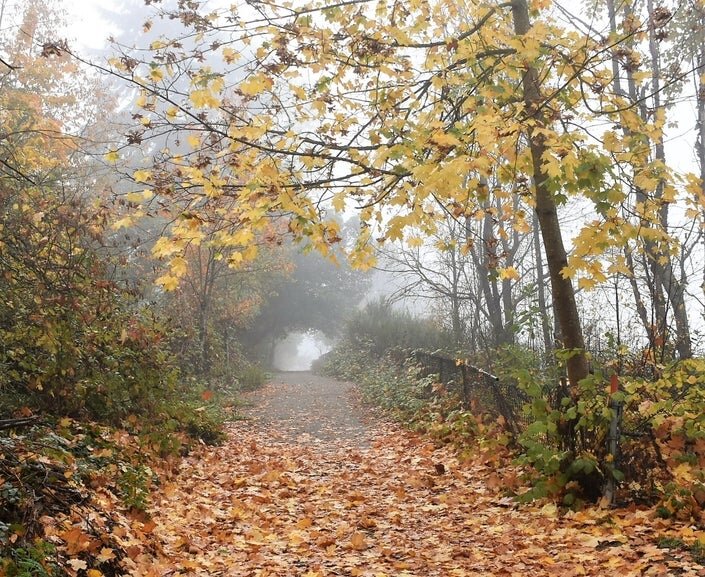
Changing leaves seen at a SeaTac park in October 2018. (Patch file photo/Neal McNamara)
SEATTLE, WA — The fall equinox on Monday, Sept. 23, officially ushers in the new season and its promise of crisp air, show-stopping leaf displays (in select parts of Washington) and more sunny afternoons in college football stadiums.
The autumnal equinox isn't a day-long event, but rather occurs at the exact moment the sun crosses the celestial equator. In Western Washington, fall officially arrives at 12:50 a.m. PST.
In Puget Sound, you can celebrate the arrival of fall with some cozy, auburn events like:
Fremont Oktoberfest, Sept. 20 – 22, Seattle
The 22nd annual Fremont Oktoberfest is the region's largest annual beer festival. The event features over 100 beer and ciders from Washington, Germany, and everywhere in between. Other cities around the region, like Kirkland and Edmonds, also hold Oktoberfest celebrations in fall.
Bellewether 2019, through Sept. 22, Bellevue
Bellevue's yearly arts-and-ideas festival takes place in multiple locations across the city through Sept. 22.
Fresh Hop Ale Festival, Oct. 5, Yakima
Washington has a unique phenomenon every autumn. Brewers descend on the Yakima area to buy un-dried, freshly harvested hops. The resulting beers are known as "fresh hop," and they're only available during this time of year.
Issaquah Salmon Days, Oct. 5 – 6, Issaquah
The 50th celebration of fall salmon runs takes over downtown Issaquah the weekend of Oct. 5. But there's more than just fish — there will be live music, a grand parade, food, and beer and wine.
Orting Pumpkin Fest, Oct 12, Orting
Think of this as Salmon Days for pumpkins. This annual event, part of the Tacoma Freedom Festival, mixes food and entertainment with activities like pumpkin carving and amusement rides.
Woodland Park Zoo Pumpkin Bash, Oct. 26, Seattle
Families are invited to the zoo (in costume, of course) to watch animals devour pumpkins AND do some trick-or-treating.
We're also coming up on the end of Daylight Saving Time, which officially ends on Sunday, Nov. 3, but that's a while off.
The word equinox comes from the Latin words "aequus," which means "equal," and "nox," which means night. That's led to the perception that everyone worldwide sees the same amount of daylight and nighttime, but it's not the absolute truth. To be precise, daylight lasts about 8 minutes longer than nighttime on the day of the equinox.
Here are five other things to know about the September equinox:
1. There's no guarantee, of course, but the chances of seeing stunning aurora borealis displays increase after the fall equinox, according to NASA. Both the spring and fall equinoxes are good aurora seasons, but autumn produces a surplus of geomagnetic storms — almost twice the annual average.
2. Nobody alive has seen a rare Sept. 21 autumnal equinox, and only young people have any hope of seeing one barring any big shifts in life expectancy. It hasn't happened on that date in many millennia, and it won't happen again until 2092 and 2096.
The date of the September equinox varies. Usually, it's on the 22nd or, as it is this year, the 23rd, but it can occur as early as Sept. 21 or as late as Sept. 24 (that hasn't happened since 1931, and won't again until 2303).
The reason: A year is defined as 365 days by the Gregorian calendar, but it takes the Earth 365 and ¼ days to orbit the sun. What this means is the autumnal equinox occurs about 6 hours later than it did the year prior, which eventually moves the date by a day.
3. Thank Canada for spectacular fall sunsets with more vivid with pinks, reds and oranges than at any other time of the year. The Weather Channel offers an explanation: Dry, clean Canadian air begins to sweep across the country, fewer colors of the rainbow spectrum are scattered by air molecules. That means the reds, oranges, yellows and pinks make it through for your sunset-viewing pleasure.
4. No matter where you are in the world, the sun will rise due east and set due west during the fall equinox (the same thing happens during the spring equinox). For the directionally challenged, it's a good time for a reset. Go outside around sunset or sunrise, find a landmark and mark the sun's location in relation to it.
5. Fall isn't just a time for the human world to start buttoning things up outside. It's rutting — or mating — season for deer, elk and moose, and males will battle it out by thrusting their antlers together until one of them gives up or dies. Swans, geese and ducks begin their migration south. Frogs burrow deep into mud holes to wait out the winter. Chipmunks retreat to their underground tunnels. Bears eat and drink almost non-stop as they prepare for hibernation. And, according to the Mother Nature Network, the male Siberian hamster goes through a huge biological change: Its testicles swell almost 17 times their normal size.